
Jesu, Joy of Man’s Desiring BWV147
J.S.Bach / Arr. Riku Fujita
Level-3 ★★★☆☆
Video
Performance + Slow TAB Tutorial
Sheet Music
Included in Collections

Classical Masterpieces Vol.1
A collection of 13 timeless classical masterpieces arranged for solo classical guitar.
From approachable shorter works to more challenging repertoire, this volume offers a wide range of pieces for players at different levels.
Purchase options
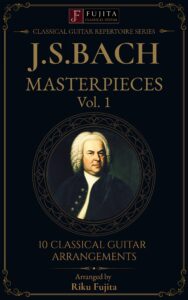
J.S.Bach Masterpieces Vol. 1
A collection of 10 well-known works by J.S. Bach, arranged for solo classical guitar.
Each piece is included in two versions: standard notation with TAB, and standard notation only, making the collection suitable both for players who prefer TAB and for those who normally read standard notation alone.
The scores also include detailed left-hand fingering and barre indications, following standard classical guitar notation to make the music clear and easy to read even without TAB.
Purchase options
About This Piece
Originally Part of a Church Cantata
Jesu, Joy of Man’s Desiring comes from J.S. Bach’s Cantata No. 147, Herz und Mund und Tat und Leben, BWV 147.
Today, the chorale is frequently performed as an independent piece and has been arranged for piano, organ, guitar, and countless other instruments. It can therefore seem like a self-contained instrumental work, but it was originally written as part of a sacred vocal composition.
The origins of BWV 147 go back to 1716, when Bach composed an earlier version of the cantata while working in Weimar. After moving to Leipzig, he substantially revised and expanded the work in 1723, creating the ten-movement version known today.
This revised cantata was first performed on July 2, 1723, for the Feast of the Visitation.
The Famous Chorale Appears Twice
Interestingly, the music now widely known as Jesu, Joy of Man’s Desiring appears twice in almost the same musical form within BWV 147.
The cantata is divided into two parts. Movement 6, which closes the first part, sets the text Wohl mir, daß ich Jesum habe, while the final movement, No. 10, uses the words Jesus bleibet meine Freude.
The familiar melody and flowing accompaniment are essentially the same, but different verses of the chorale text are sung in the two movements.
Over time, this particular music became far more widely known than the cantata as a whole and is now one of the most familiar pieces associated with Bach.
A Melody That Predates Bach
The central chorale melody itself was not originally composed by Bach.
It is based on the seventeenth-century chorale tune Werde munter, mein Gemüte, composed by the German musician and violinist Johann Schop and published in 1642.
Bach took this existing melody and surrounded it with the distinctive continuously flowing triplet accompaniment and rich harmony that have become inseparable from the piece today.
The contrast between the calm, measured chorale melody and the gently moving accompaniment creates one of the work’s most characteristic effects. Although the music feels peaceful, the constant motion underneath keeps it moving naturally forward.
From a Cantata Chorale to a Worldwide Favorite
During the twentieth century, the chorale became increasingly popular as an independent concert piece.
In the English-speaking world it became widely known as Jesu, Joy of Man’s Desiring, and arrangements for instruments such as piano and organ helped bring the music to an audience far beyond performances of the complete cantata.
In 1926, the British pianist Myra Hess published her celebrated piano transcription under this title, and the arrangement remains a well-known recital piece today.
The music has since become familiar in concerts, ceremonies, weddings, and countless instrumental arrangements, making it one of Bach’s most universally recognized works.
About This Classical Guitar Arrangement
This classical guitar arrangement follows the harmony and overall musical progression of Bach’s original as closely as practical.
Rather than radically reworking the melody, it takes a relatively traditional approach, preserving the main theme while also incorporating important bass and inner-voice movement wherever possible on a single guitar.
The aim is to retain the sense of several musical voices moving together, as well as the continuous flow surrounding the chorale melody, while presenting the music naturally within the sound and technique of the classical guitar.
Playing Tips
Notice How the Bass Changes When the Theme Returns
The familiar opening theme returns several times throughout the piece.
Although the melody may appear almost identical each time, the bass and accompanying voices change slightly from one statement to another.
Once the main melody becomes familiar, it is easy to concentrate only on the upper voice. When the theme returns, however, do not automatically assume that everything underneath it is the same. Pay attention to the changing bass patterns and inner voices as well.
Keep the Quarter-Note Bass Moving Continuously
The bass line itself is relatively simple, consisting largely of steady quarter notes.
However, this continuous quarter-note motion is one of the elements that keeps the entire piece moving forward.
If you release a bass note too early while preparing the next left-hand position, an unwanted gap can appear between the notes and the musical flow may begin to feel interrupted.
Try to sustain each bass note for as close to its full value as possible before moving smoothly into the next one.
There is no need to hold a note so long that the following attack becomes difficult or untidy. The goal is simply to make the listener feel that the bass continues its steady motion without unnecessary breaks.
Always Know Which Voice Has the Melody
In the earlier part of the arrangement, the location of the main melody is relatively easy to identify. As the piece develops, however, the relationship between the different voices becomes more varied.
The shape of the theme begins to change, and important melodic material can move from the upper voice into another register.
In particular, from measure 36, the melody moves into the lower voice. If the upper notes continue to be emphasized in the same way as before, the actual melody can easily become buried beneath the accompaniment.
Rather than thinking only in terms of high notes and low notes, always ask yourself which notes belong to the melody and which belong to the accompaniment.
Change the Balance When the Melody Changes Voices
When the melody moves into the bass, the balance of the guitar should change with it.
Bring the lower melodic notes slightly forward and allow the upper notes to take a more supporting role. When the melody eventually returns to the upper register, shift the balance back again.
Thinking of the melody as something that is passed from one voice to another can make the texture much clearer and help the arrangement sound more expressive and three-dimensional.
Piece Information
- Composer
- J.S.Bach
- Arranger
- Riku Fujita
- Difficulty
- Level-3 ★★★☆☆
- Tuning
- Regular Tuning