
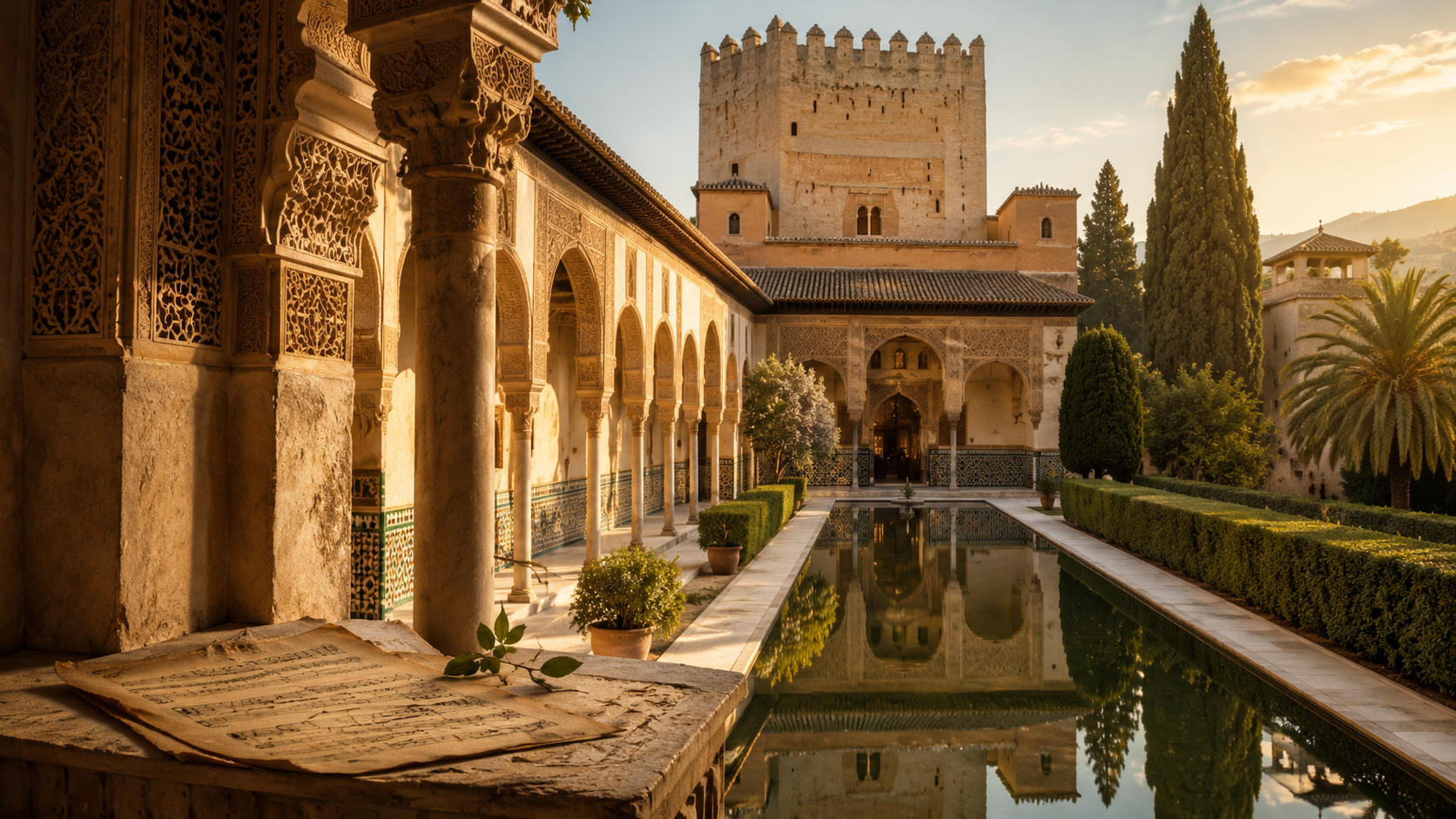
One of the best-known masterpieces of the classical guitar repertoire is Francisco Tárrega’s Recuerdos de la Alhambra.
Its continuously flowing tremolo melody, accompanied by a gently moving bass line, creates an atmosphere that seems to reach back toward a distant memory. Even for listeners unfamiliar with classical guitar, its sound can leave a powerful impression.
The piece is famous as a technically demanding work built around the tremolo technique, but it is also music that reveals the guitar’s remarkable ability to “sing.”
In this article, we will take a detailed look at Recuerdos de la Alhambra: its historical background, the meaning of its title, its tremolo technique, musical structure, listening points, and the reasons it is so difficult to perform.
What Is Recuerdos de la Alhambra?
Recuerdos de la Alhambra is a solo classical guitar work by the Spanish composer and guitarist Francisco Tárrega.
Its Spanish title, Recuerdos de la Alhambra, is commonly translated into English as Memories of the Alhambra or Reminiscences of the Alhambra.
The most distinctive feature of the piece is the tremolo technique used through almost its entire length.
In classical guitar tremolo, the thumb plays bass notes and chords while the ring, middle, and index fingers rapidly repeat the melody notes. The result is an illusion of sustained sound: although each guitar note naturally begins to fade almost immediately after it is plucked, the repeated notes can make the melody seem to continue without interruption.
Emilio Pujol, one of Tárrega’s pupils and an important figure in preserving his technique for later generations, described Recuerdos de la Alhambra as a study in tremolo while also praising the beauty of its melody. He emphasized that its dreamlike effect depended not only on the technique itself, but also on Tárrega’s soft touch, refined artistry, and depth of feeling (Pujol, 1960).
In other words, Recuerdos de la Alhambra is not simply a piece designed to display tremolo technique.
Its central musical idea is to use tremolo to give the guitar the illusion of a sustained, singing line.
Francisco Tárrega
Francisco Tárrega was born in Villarreal, Spain, in 1852 and died in Barcelona in 1909.
He is one of the most important figures in the history of the modern classical guitar and is sometimes described as one of the fathers of the modern classical guitar tradition.
In addition to Recuerdos de la Alhambra, he composed many works that remain central to the guitar repertoire, including Capricho Árabe, Lágrima, Adelita, and Marieta. He also arranged music by composers such as Bach, Beethoven, Chopin, and Albéniz, helping to expand the range of music available to guitarists.
During the second half of the nineteenth century, when Tárrega was active, the guitar did not enjoy the same status as concert instruments such as the piano or violin. Its relatively limited volume meant that it was often considered unsuitable for large concert halls.
At the same time, important developments in guitar making were taking place. Antonio de Torres introduced innovations that helped shape the instrument into what would become the modern classical guitar. Tárrega performed on Torres guitars and explored new possibilities in tone, technique, and repertoire.
Tárrega did not single-handedly create the modern classical guitar tradition. Nevertheless, his performances, compositions, arrangements, and teaching had a profound influence on later generations of guitarists (Clark, 2010).
Recuerdos de la Alhambra can be seen as one of the clearest expressions of his musical ideals.
The Background of the Piece — When Was Recuerdos de la Alhambra Written?
The Alhambra Palace
No discussion of Recuerdos de la Alhambra is complete without considering the Alhambra itself, located in Granada in southern Spain.
The Alhambra is a palace and fortress complex that preserves an important part of the history of Islamic culture on the Iberian Peninsula.
Its intricate architectural decoration, reflecting pools, quiet courtyards, and gardens create a world in which architecture and nature seem to merge. For centuries, the Alhambra has inspired artists, writers, and musicians.
Tárrega also visited the Alhambra, and the impressions he received there are believed to have inspired the guitar piece we know today.
However, when we examine when and how Recuerdos de la Alhambra actually came into being, the story becomes more complicated.
Two important clues survive: an account transmitted by Tárrega’s pupil Emilio Pujol that points to 1896, and an autograph manuscript dated 1899.
1896 — The Story Told by Emilio Pujol
According to Emilio Pujol’s biography of Tárrega, the composer traveled through Andalusia in 1896 and visited Granada, where he saw the Alhambra at dusk.
Pujol relates that later that evening, after returning to his lodging, the impressions of the Alhambra returned vividly to Tárrega’s mind. He then wrote down the tremolo idea that would eventually become Recuerdos de la Alhambra (Pujol, 1960).
Walking through the palace at sunset, absorbing its silence and scenery, and then returning to the guitar later that night—
It is an evocative story that seems perfectly suited to the dreamlike sound of the music. For this reason, the account that Tárrega conceived the piece on the night of his visit to the Alhambra has been repeated frequently.
However, Pujol’s biography was published roughly half a century after Tárrega’s death.
For that reason, the story alone cannot establish that the work in the form we know today was completed in 1896.
A later-discovered autograph manuscript provides another important clue.
1899 — Another Title in Tárrega’s Manuscript
In 1991, musicologist David J. Buch brought attention to an autograph manuscript by Tárrega connected with the work now known as Recuerdos de la Alhambra.
The manuscript is dated December 8, 1899, in Málaga.
Most intriguingly, however, the title written on the manuscript is not Recuerdos de la Alhambra.
Instead, it reads:
Improvisación ¡A Granada! Cantiga Árabe
or approximately:
Improvisation “To Granada!” — Arab Song
The familiar title Recuerdos de la Alhambra suggests a quiet act of looking back on a place that has already passed into memory.
By contrast, the words ¡A Granada! — “To Granada!” — have a more immediate sense of emotional movement toward the place itself. The subtitle Cantiga Árabe, or “Arab Song,” also brings the Alhambra’s historical and cultural associations more directly to the foreground.
The music may be the same, but a different title can change the scene we imagine around it.
A “Poetic Impression” Dedicated to Conchita
The manuscript was dedicated to Concepción Gómez de Jacoby, known as Conchita, who was both a patron and pupil of Tárrega.
At the end of the manuscript, Tárrega also wrote words indicating that the piece was a small “poetic impression” inspired by the Alhambra that the two of them had seen together (Buch, 2020).
This suggests that the composition was not simply inspired by a famous monument in the abstract.
It appears to have grown out of an actual experience and memory shared by Tárrega and Conchita.
It may therefore have been a memory not only of the Alhambra itself, but of a landscape seen together with another person.
When the work was later published, its title had become Recuerdos de la Alhambra, and the dedication was instead made to the French guitarist Alfred Cottin, a friend of Tárrega.
Both the title and the dedicatee had changed.
If we look only at the commonly known published edition, the connection between the piece and Conchita disappears almost entirely.
The 1899 manuscript therefore preserves a more personal layer of the work’s history—one that largely vanished from view during the publication process.
Conceived in 1896, Completed in 1899?
So was Recuerdos de la Alhambra created in 1896, or was it composed in 1899?
What can be established with certainty is that an autograph manuscript closely connected with the work as we know it today is dated December 8, 1899, in Málaga.
At the same time, Pujol tells us that Tárrega drew inspiration from his visit to the Alhambra in 1896.
These two accounts are not necessarily incompatible.
It is possible that Tárrega conceived an initial melody or musical idea during the 1896 visit, retained that memory for several years, and eventually shaped it into a finished composition in 1899.
However, no sketches, letters, or other surviving documents have been identified that directly demonstrate this process.
We therefore cannot state with certainty that the work was “conceived in 1896 and completed in 1899.”
Was it born during a single evening?
Or did Tárrega’s impressions of the Alhambra remain with him for several years before gradually becoming music?
The exact compositional process remains uncertain.
That is why the history of Recuerdos de la Alhambra contains both documented evidence preserved in the autograph manuscript and the beautiful story handed down by Tárrega’s pupil.
Perhaps the space between those two versions is itself strangely appropriate for a piece whose title speaks of memory.
Tremolo and the Sound of Memory
As we have seen, the title Recuerdos de la Alhambra was not necessarily attached to the piece from its earliest surviving form.
And yet today, it is almost impossible to separate the idea of “memory” from the sound of its tremolo.
Why does the idea of remembrance seem to suit this music so naturally?
One reason lies in the unusual way tremolo is perceived by the ear.
Not a Landscape Before Our Eyes, but One Remembered
Recuerdos de la Alhambra does not attempt to describe the physical appearance of the palace in a literal way.
It does not depict the architecture, courtyards, and gardens one by one.
Instead, the music seems to transform the impression left behind after leaving the Alhambra into a continuous song.
The melody has a clear shape, and yet at the same time it can feel as though it is sounding from somewhere far away.
It is not quite a landscape in front of us, but a landscape remembered across a distance in time.
Something that feels close, yet can no longer be touched.
The endlessly repeated notes of the tremolo help create that sense of distance.
A Guitar Cannot Truly Sustain a Note
The classical guitar produces sound by plucking a string.
Once a note has been played, it immediately begins to decay and eventually disappears.
Unlike a violin, the guitar cannot continue moving a bow across the string to sustain the sound. Nor can it keep sending air through a note in the way a singer or wind player can.
This natural decay is part of the guitar’s beauty.
But when a guitarist wants a melody to sing in long, sustained phrases, it also becomes a fundamental limitation.
Tremolo provides one solution.
In Recuerdos de la Alhambra, the thumb plays bass notes and chords while the ring, middle, and index fingers rapidly repeat the melody.
To the ear, the result can sound like a single sustained tone.
In reality, however, what we are hearing is a sequence of many short notes.
Creating an Unbroken Song from Disappearing Notes
Each individual tremolo note begins to disappear almost as soon as it is played.
Yet when those short notes continue in a sufficiently even stream, our ears stop perceiving them as completely separate sounds and begin to hear them as a connected melodic line.
This is one of the unique beauties of guitar tremolo.
The melody is not truly sustained in the way it would be by a violin or human voice.
Instead, many small sounds appear and disappear one after another, while beyond them the illusion of a single long song seems to emerge.
Writing about another tremolo work by Tárrega, Sueño, Emilio Pujol described tremolo as a technique that in some measure solves the problem of sustaining melody on a plucked-string instrument (Pujol, 1960).
But what Tárrega achieved in Recuerdos de la Alhambra goes beyond a technical solution.
Sounds that should disappear seem to become a song that refuses to disappear.
That tension between fragility and continuity closely resembles the experience of memory itself: something that has already passed, yet continues to live in the mind.
Tremolo Should Not Sound Like Mere Repetition
Tremolo is, technically speaking, the rapid repetition of the same note.
But when listening to Recuerdos de la Alhambra, the repeated notes themselves are not the most important thing.
What matters is where the melody is going.
Where does tension increase?
Which note is the phrase moving toward?
Where does it finally relax?
Rather than following each individual tremolo note, we need to hear the larger melodic line behind them.
Even perfectly even tremolo can sound mechanical if the melody has no direction or breathing.
On the other hand, when the line flows naturally as a single song, listeners may stop noticing the rapid movements of the right hand altogether.
What remains is no longer tremolo as a technique, but a quietly breathing melody.
Perhaps the true difficulty of this piece lies not simply in repeating notes quickly, but in making the listener forget that they are being repeated at all.
From A Minor to A Major and Back Again — Structure and Listening Guide
Although Recuerdos de la Alhambra uses essentially the same tremolo texture throughout most of the work, its musical structure contains important changes.
At the broadest level, the piece consists of an A section in A minor, a B section in A major, and a Coda also in A major.
Following the repeat signs in the score, the sections appear in the following order:
A (minor) → A → B (major) → B → A (minor) → B (major) → Coda (major)
The opening A and B sections are each played twice. The music then returns once more to A, moves again into B, and finally continues into the Coda.
In other words, the piece does not simply travel in a straight line from a dark minor key toward a bright major key.
Instead, it moves back and forth between A minor and A major before finally settling into the major mode at the end.
A Section — An Inward-Looking Song in A Minor
The A section begins in A minor and has a quiet, introspective character.
The melody flows continuously, but it is not simply drifting in place.
As it rises, the emotional tension gradually increases. As it descends, the music seems to recover its calm, almost as though looking back on something.
Rather than placing us directly before the splendor of the palace, the music seems to trace a landscape that remains in the mind after we have already left it.
At the same time, it would be too simple to describe the A section merely as “sad.”
Its expression also contains nostalgia, longing, and a gentle warmth.
Part of the beauty of the melody lies precisely in the fact that it cannot easily be reduced to a single emotion.
At the beginning of the work, this A section is repeated.
By hearing the same melody once again, the music begins to feel less like a single event and more like a memory returning repeatedly to the mind, becoming more deeply engraved each time.
B Section — A Major, and Light Falls Across the Same Landscape
When the B section begins, the key changes from A minor to A major.
The tremolo continues without interruption, yet the color surrounding the music changes dramatically.
The inward-looking atmosphere of the A section seems suddenly to open outward, as though a soft light has fallen across the same landscape.
But this brightness is not simple happiness that erases everything that came before.
Because we have already heard the A-minor melody, the A-major section still carries traces of nostalgia and lingering emotion.
It can sound less as though sadness has disappeared and more as though the same memory has taken on a calmer, gentler expression.
In the first part of the piece, this B section is also played twice.
Repeating the A-major melody allows its brighter sound to expand into a complete musical world rather than appearing as only a brief contrast.
Tárrega did not provide a specific narrative for the piece, so images such as these are ultimately interpretations suggested by the music rather than literal programmatic descriptions.
Even so, one of the work’s great subtleties is that the tremolo itself remains unchanged while the harmony transforms its emotional color from darkness to light.
Returning to A — A Minor After We Have Heard the Light
After A and B have each been heard twice, the piece does not simply continue into the Coda.
Instead, it returns to the A-minor A section.
This return is one of the most important structural features of Recuerdos de la Alhambra.
The notes of the returning A section are the same as at the beginning.
But listeners have now experienced the brighter A-major world of the B section, and as a result the returning A-minor melody can feel different from the way it did at the opening.
At first, A minor was the starting point. Now it becomes a return to a place we had left behind.
After glimpsing a brighter landscape, we are drawn once again into a quieter world of memory.
The same melody can carry a different emotional meaning simply because of where it appears within the structure.
By returning to A, Recuerdos de la Alhambra avoids becoming a simple transformation from minor to major.
Instead, it creates a sense of time moving backward and forward, like memory itself.
B Once More — From A Major into the Coda
After returning to A, the music once again moves into the B section.
Because A minor has just reappeared, the return of A major can feel even more open and expansive than before.
This time, however, B leads directly into the Coda, which remains in A major.
After moving back and forth between A and B, the music finally takes up the brighter sonority of the B section and closes quietly through the Coda.
Viewed as a whole, the piece therefore follows a striking emotional trajectory:
- A memory appears in A minor and moves toward the light of A major.
- Then it returns once more to A minor before turning again toward A major for the final close.
Rather than simply progressing from darkness into light, the music revisits both worlds before ending with a sense of brightness that still carries the memory of what came before.
単に暗い場所から明るい場所へ進むのではなく、二つの響きのあいだを往復した後で、明るさの中に余韻を残して閉じるところに、この曲ならではの物語性があります。
Another Voice Singing Beneath the Melody
When following the structure of the piece, listen not only to the high tremolo melody but also to the bass line played by the thumb beneath it.
The bass is not simply an accompaniment marking the beat.
It moves independently from the melody, shaping the harmonic progression and supporting the sense of transition from A to B and from B back to A.
Above, there is a continuously flowing melody. Below, there is a slower-moving bass line.
The two voices seem to inhabit different kinds of musical time, yet they support each other.
As a result, even though a single guitarist is playing a single instrument, the music can acquire the depth of two voices quietly singing together.
The beauty of Recuerdos de la Alhambra is therefore not created by tremolo alone.
The relationship between the flowing upper melody and the guiding bass helps make the contrasting keys and characters of the A and B sections much more vivid.
The Piece Is About More Than Tremolo Speed
The first thing that attracts our attention in Recuerdos de la Alhambra is naturally its seemingly endless tremolo.
But once we understand the structure of the piece, we can begin to hear the larger musical movement beneath the surface.
How do the first A and B sections differ?
After hearing the B section in A major, does the returning A-minor section sound the same as it did at the beginning?
Does the final B section feel different from its earlier appearances?
And how does the Coda bring together music that has repeatedly moved between two tonal worlds?
It is also worth listening to the direction of the melody, the movement of the bass, and the ways in which the harmony gradually changes color.
When we listen to these larger processes, the piece stops being simply “a beautiful tremolo piece” and reveals itself as carefully constructed music built around repetition, return, and transformation.
The important question is not how fast the guitarist’s fingers are moving.
It is where the music has come from, where it returns, and where it is ultimately going.
Listening in this way helps reveal why Recuerdos de la Alhambra has endured as something much more than a display of technique.
Tárrega and the Importance of Tone
Tárrega was known as a guitarist who placed great importance on tone quality.
Accounts of his right-hand technique suggest that around the beginning of the twentieth century he gradually shortened his nails and eventually moved toward playing primarily with the flesh of the fingertips rather than relying heavily on the nails (Gimeno García, 2004).
However, because the surviving manuscript of Recuerdos de la Alhambra is dated 1899, it would be misleading to connect the composition directly with Tárrega’s later nail-less technique.
We should therefore be cautious when speculating about the precise condition of his nails when he performed the piece, or exactly what kind of tone he had in mind when composing it.
Even so, Tárrega’s broader concern with softness, depth, tone quality, and the singing character of melody remains highly relevant to the way Recuerdos de la Alhambra can be approached today.
The goal is not simply to produce a loud, clearly articulated sound.
The upper melody needs to float smoothly above the accompaniment, while the bass quietly supports it underneath, allowing everything to blend into a single musical texture.
This is a piece in which quality of tone matters more than sheer volume, and melodic flow matters more than speed.
Why Is Recuerdos de la Alhambra So Difficult to Play?
For many classical guitar students, Recuerdos de la Alhambra is a dream piece.
In practice, however, it is extremely difficult to perform well.
The greatest challenge is naturally the tremolo. But simply being able to move the fingers of the right hand quickly is not enough to make the piece sound beautiful.
The repeated notes must be heard not as rapid attacks, but as a single melody.
If the volume or spacing of the right-hand notes is uneven, the melody can sound as though it is shaking or breaking apart.
If the bass notes and chords played by the thumb are too strong, the tremolo melody can disappear into the accompaniment.
Even when the right hand is stable, shifts and fingering changes in the left hand can interrupt the melodic line.
Some of the most important points to consider when performing the piece include:
- Keeping the volume and spacing of the tremolo notes as even as possible
- Bringing the upper melody forward above the accompaniment
- Avoiding excessive volume in the bass notes and chords played by the thumb
- Preventing left-hand shifts from interrupting the melody
- Thinking about the overall direction of the phrase rather than individual notes
- Identifying the high points and endings of phrases
- Prioritizing tone and musical flow over speed
The score is marked Andantino, a tempo indication generally suggesting a moderately flowing, walking pace.
Of course, actual tempos vary considerably among performers.
But if the music is rushed simply to make the tremolo sound more impressive, it is easy to lose the breathing of the melody and the reflective atmosphere of the piece.
Recuerdos de la Alhambra is not music written to display speed for its own sake.
The greatest challenge is to make the listener hear a natural, continuous song beyond the individual repeated notes.
Why Is Recuerdos de la Alhambra a Masterpiece?
The lasting appeal of Recuerdos de la Alhambra cannot be explained simply by the difficulty of its tremolo.
The classical guitar repertoire contains many other works that demand advanced technique. Some are technically more complex than Recuerdos de la Alhambra.
What makes this piece special is the way technique and musical expression become inseparable.
A guitar note begins to disappear from the moment it is plucked.
Rather than treating that characteristic simply as a limitation, Tárrega transformed it into a uniquely guitaristic form of expression: many small, fading sounds combine to create the illusion of a single continuous song.
The tremolo melody seems sustained.
But if we listen closely, it is always made of notes that are constantly being born and disappearing.
This paradox—creating an enduring song out of sounds that are continually fading away—gives Recuerdos de la Alhambra much of its unique poetry.
The movement between A minor and A major, the dialogue between the upper melody and the bass, and the gradually shifting harmony all add further depth to the music.
And the title Recuerdos de la Alhambra adds a sense of distance in time.
This is not a landscape directly before us.
It is one that has already passed and now remains only in memory.
The shimmering tremolo can sound almost like that distant memory itself, appearing and trembling at the edge of consciousness.
Pujol acknowledged that the repetitive nature of tremolo could potentially become monotonous, yet he regarded the melody of Recuerdos de la Alhambra as something capable of enduring beyond its time (Pujol, 1960).
Although the piece displays remarkable technique, what remains in the listener’s memory is not the technique itself.
It is the quiet, continuous melody.
Perhaps that is why Recuerdos de la Alhambra has gone far beyond the status of a tremolo study and become one of the defining masterpieces of the classical guitar.
Conclusion
Recuerdos de la Alhambra is one of Francisco Tárrega’s most celebrated works for solo classical guitar.
Its origins are not completely straightforward.
A tradition passed down by Emilio Pujol associates the inspiration for the work with Tárrega’s visit to the Alhambra in 1896, while the surviving autograph manuscript is dated December 8, 1899, and contains a dedication to Concepción Gómez de Jacoby together with words referring to impressions of the Alhambra that the two had shared.
The manuscript bears the title Improvisación ¡A Granada! Cantiga Árabe, rather than the familiar Recuerdos de la Alhambra under which the piece was later published.
The tremolo at the heart of the composition is far more than a technical effect.
By rapidly repeating guitar notes that naturally fade almost immediately, Tárrega creates the illusion of a sustained melodic line and gives the guitar a distinctive kind of singing voice.
The inward-looking A-minor passages and brighter A-major sections, the relationship between the upper melody and the supporting bass, and the strange transformation of countless individual notes into one continuous song all contribute to the dreamlike world of the piece.
Recuerdos de la Alhambra is therefore both a formidable tremolo work and a composition that transforms one of the guitar’s fundamental physical characteristics into music.
More than a century after it was written, it continues to be performed by guitarists around the world and remains one of the most beloved works in the classical guitar repertoire.
References and Sources
Emilio Pujol, Tárrega: Ensayo biográfico, Lisboa: Talleres Gráficos de Ramos, Afonso & Moita, 1960.
Open Library 書誌情報
David J. Buch, “Concepción Gómez de Jacoby: Tárrega’s Enigmatic Patron and Recuerdos de la Alhambra,” Musicological Trifles and Biographical Paralipomena, 2020.
論文掲載ページ
Walter Aaron Clark, “Francisco Tárrega, Isaac Albéniz, and the Modern Guitar,” Soundboard, Vol. 36, No. 1, 2010.
Guitar Foundation of America・Soundboard Archive
Julio Gimeno García, “The ‘Tárrega School’ According to the Methods of Pascual Roch and Emilio Pujol,” Soundboard, Vol. 30, No. 3, 2004, pp. 9–24.
著者公開資料